 I didn’t try the legendary Iroshizuku ink until quite recently when a pen friend sent me a sample of the shin-ryoku. Since this ink is both legendary and expensive – now even more so since Pilot’s price increase – the expectations are high and my judgement harsher than with a cheaper ink. An ink in this price range – what do they put in it to make it so expensive?!? – is not supposed to perform less than top-notch.
 I seldom find it necessary to mention the bottle, but in this case I actually find it appropriate to do so since the bottle in itself is a exquisite combination of aesthetics and function. Unlike Caran d’Aches beautiful, but so very impractical bottles, these bottles are – in accordance with the Japanese tradition – made to be used as well as please the eye. The little crater in the middle shows that the designers know what fountain pen users want: a possibility to fill the pen even when the ink level is very low. I like that very much and that in itself actually adds some extra value to the iroshizuku line; the bottle can be used as an inkwell when the original ink is gone.
 Some might remember that I was slightly disappointed in the shin-ryoku. It is not a bad ink, but the “wow” that I think one should feel when using such an expensive and widely acclaimed ink didn’t just wasn’t there. This has – on the other hand – been on my list of “would very much like to try” inks for quite some time, so I was thrilled to try it.
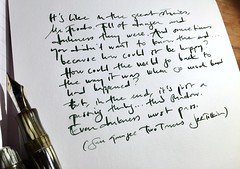
 This colour is quite hard to describe. I’d say that it is a little too bright and orangey to be vermillion and too red to be a regular orange. It also has a very special hue of apricot that softens it and takes the edge out of it without making it meek or like a pastel. This makes it easier on the eyes and thus suitable even for letters if one wants to cheer up the recipient. What I did notice is that it is duller on a porous and creamy paper as the Moleskine below since it absorbs the colour and thus deprive it from a lot of shading compared to when it is used on a white paper with better quality (above). This is an ink that is much more vibrant and exciting when used on a paper and in a nib that lets it shade and shine. I really like this, slightly dreamy, dark orangish-red colour – it is original in a way that I expected of an ink with this rep and price.
 Beside the colour it also features some real nice characteristics: the flow and lubrications is excellent. The Rotring Artpen with a 2.7 mm broad italic nib is somewhat dry, tired and picky with inks and it wrote wetter and better with any other ink I’ve tried in it so far. It didn’t hesitate or skip and that ought to be a good verdict of lube and flow. The non-picky Talentum also liked this ink and, since it is a wetter nib, the ink shaded beautifully in the Talentum’s italic nib – they got on very well together.

 Looking at the other writing properties it gets a very good grade as well. Its bleed through on Moleskine is bad – but so are basically all inks in a broader nib. The good news is that even if it bleeds through on Moleskine paper it still only shows very minor – almost none – feathering; despite the use of broad nibs. On paper of better quality than the Moleskine – the featured sketch paper, Rhodia, Habana and ordinary copy paper etc – it shows basically no feathering at all and very modest bleed through tendencies – even with broader nibs. It is thus both well behaved inside the pen – flow – and on paper.

In all this is thus an excellent ink with an original colour in a bottle that is both beautiful and functional. If it is worth the price? I think that is hard to say, actually. If one wants the colour badly enough (and it is original) it is an ink of very high quality, but I have yet to decide if I think the price can be justified in the long run. But, I am happy to have it and I love the colour. The big drawback is thus the price.


 It has surely been some time since I last posted any wind wanes, but here are two fresh photos. One is from the top of little building that once belonged to an iron works and it states that it was made 1738 – A little more than 270 years ago… The other is from an old station building in what once was a flourishing little village with a majestic railway station house, a big postal building and a proper courthouse. The wane states “NS” which I think stands for “National Railways”
 and is probably of the same age as the building – from 1859. The sign below is an anniversary sign from the very same building from the 125th anniversary of this specific railway in 1984. It states that this is a part of the first completed railway in Sweden. It is something special with deteriorated, partly abandoned places who has past their prime, but where the traces are still present – reminding the visitor of the past glory and another time. This little village is still alive with some services like hairdressers, cafés, grocery stores and pharmacy – and thus not wholly abandoned, but it is still far from the busy industrial place it once was.



 lady dandelion